Site, app or AI automation: what to actually start with
You don't need all of it. You need the one thing that brings the most customers or saves the most hours, in that order. An honest prioritization guide.
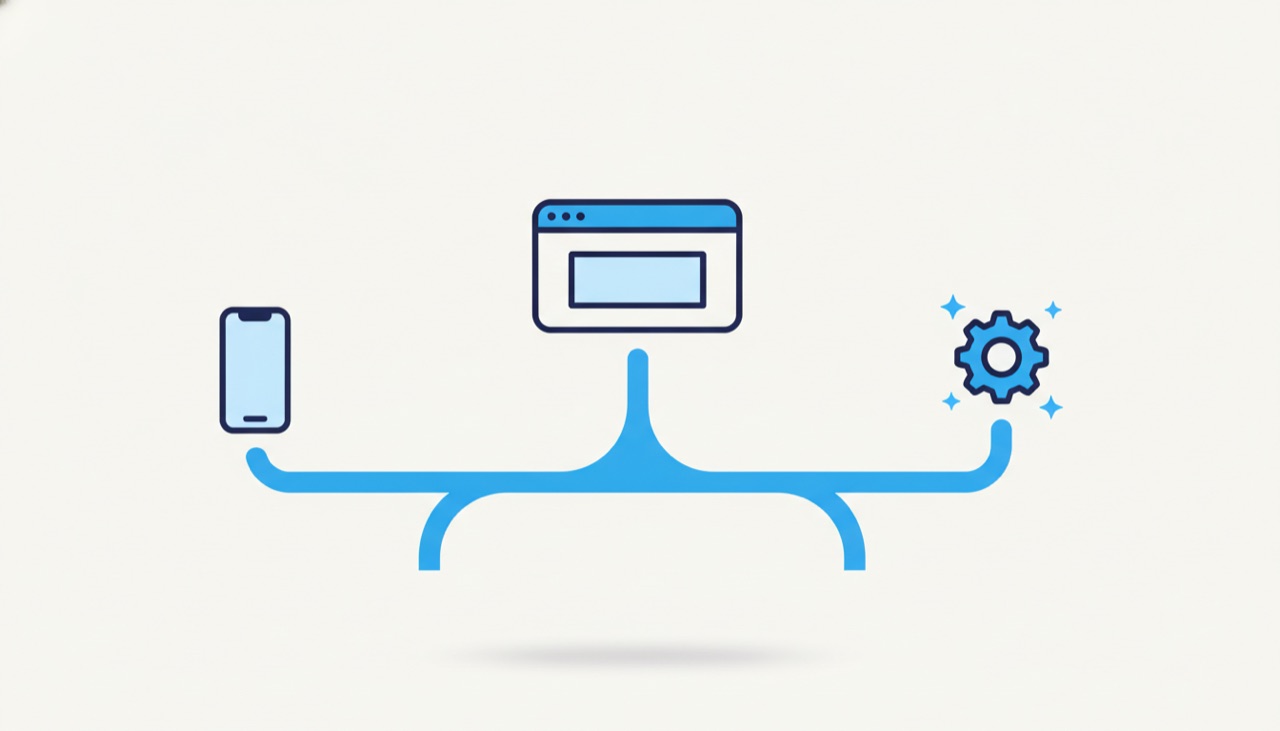
The most expensive mistake you can make in your business is not picking the wrong technology. It’s building something you don’t need yet.
Let’s put things in order.
First: what hurts right now?
Don’t ask “what would be cool to build?”. Ask “what is costing me money or hours right now?”. The answer tells you where to start.
- Not enough customers → the problem is visibility + conversion. Start with a fast site that brings in calls, not an app.
- Customers, but hours lost on repetitive work (replies, bookings, follow-ups) → start with automation, not a new site.
- Customers who use you often and repeatedly (bookings, loyalty, repeat orders) → only here does a mobile app make sense.
The test is simple: if you can’t say in one sentence what problem the thing you want to build solves, and what that problem costs you per month, it isn’t time yet.
Why you (almost) don’t need an app
It’s the most requested thing and the least often necessary. A local business doesn’t need an app: nobody downloads their plumber’s or their clinic’s app. What they need is a site that shows up fast on a phone.
The reason is mechanical, not aesthetic. An app carries an install barrier a site doesn’t have: you have to convince someone to go to the store, download, accept notifications, create an account. Every step loses people. A site only asks them to click a Google result.
An app starts to make sense when that barrier pays for itself, which is when people come back. The concrete signals you’re there:
- The same customers interact with you several times a month, not a few times a year.
- You already have a flow that works on the web and that people use repeatedly, not one you hope they’ll use.
- You need something a browser genuinely can’t do well: offline operation, real-time maps, access to the phone’s cameras and sensors.
- Notifications would be useful to the customer, not only to you.
If you tick just one, it isn’t time. The costs an app implies, including the ones that only start after launch, are in how much a mobile app costs.
Where automation wins
The neglected part. If your team loses hours on:
- answering the same questions,
- following up after a quote,
- moving data manually from one place to another,
- preparing the same reports every Monday morning,
then a simple automation gives you the time back and reduces mistakes. It’s the best effort-to-result ratio for many businesses, and almost nobody starts it in time.
The calculation worth doing before any technical discussion: count the hours. How many hours a week go into that task, times the cost of an hour in your company, times 52. If the number is bigger than the build cost, the automation pays for itself in the first year. If not, you’ve found something annoying, not something expensive, and the difference between those two is a budget.
Not sure which of the three situations you’re in? Ask for a free audit or book a 30-minute call. We look at what you have and tell you honestly what the first step with real impact is, even when the answer is “don’t build anything this year”.
The reverse mistake, seen less often
There’s also the opposite situation, rarer but more expensive: you build a site that brings in quote requests and discover nobody can process them. Marketing that works on top of an operation that can’t keep up produces unhappy customers faster than it produces revenue.
If you already can’t get back to every request you have, your problem isn’t visibility. It’s capacity, and there automation comes before the site.
The right order
- A site that converts (if you’re short on customers).
- Automation (if you’re short on time).
- An app (if you already have repeat usage and want retention).
Build in the order of the pain, not the order of the excitement. The rest is wasted budget.
One more thing: this order isn’t a ladder you have to climb to the top of. Plenty of businesses stop healthily at step 1 or 2 and do well. An app isn’t the next level of seriousness, it’s the right tool for one particular kind of customer relationship.
Frequently asked questions
Do I need an app or is a website enough? If people interact with you a few times a year, a site costs less, gets found in Google and requires no install. An app becomes justified when the same customers return several times a month, or when you need features a browser doesn’t cover.
Where does a business with nothing online start? With a site that loads fast on a phone and answers what customers search for in Google. It’s the only one of the three that brings in new people. Automations and apps solve problems that appear after you already have customers.
How much does each of the three cost? The published market ranges are in how much a website costs and how much a mobile app costs. For automations there are no comparable published ranges, because each one depends on the systems you already run.
How do I know if an automation is worth it? Count the hours per week that go into the task, multiply by the cost of an hour in your company and by 52 weeks. If the total exceeds the build cost, it pays for itself in the first year.
Can I do all of them at once? You can, but you pay three times up front and delay the result from each. One thing carried through and measured beats three started in parallel, especially when the budget is yours and not an investor’s.
Not sure where to start? Ask for a free audit: we look at your business and tell you honestly what the first step with the biggest impact is. Or go straight to a 30-minute call, no strings attached.
Want the same result for your business?
We send a free audit within 48h: 5 things to fix and 3 growth opportunities. Or jump straight into a 30-minute call, no strings attached.